
Research
Academics
About me
650 N A'Ohoku Place
Hilo-96720, Hawaii
USA
garima.singh@obspm.fr
Ph: +1 (808) 934 5966
Fax: +1 (808) 934 5984
Subaru Telescope
LESIA
ex.o.plan.et
noun: a planet that orbits a star outside the solar system.
I am involved in the development of a versatile cutting-edge instrument that aims for imaging the exoplanets directly.
The night sky full of thousands of stars has always made us wondered if God did play dice and made our existence as unique as it looks like? Does the pale blue dot as spotted by the famous voyager mission is the only blue spec of life in the vastness of the nothingness? Was it merely a coincidence that everything has fallen together at the right time at the right place and led to the creation of species that could breathe, feel and wonder? Are their other forms of civilization somewhere asking the same questions to themselves? Don't we want to ask if there exists other worlds like ours?
As I read in Jane Goodall's book 'Reason for hope':
Nothing that we know of a habitable planet like ours as of today but we as humans are equipped with the advanced technologies where we can point our gaint telescopes either from the ground or from the space and search for the exoplanets outside of our own solar system. There are several techniques through which the discovery of exoplanets can be conducted, broadly divided into "Indirect" and "Direct" methods. Indirect method includes the study of the effects induced by a planet in the surrounding of the parent star while the direct methods includes imaging a planet directly.
Through indirect methods, NASA's space telescope Kepler has already confirmed more than 100 exoplanets in the habitable zone (HZ) of the star, few of which are Earth-size. Such confirmations gives us the idea of their abundancy out there! In order to understand the atmospheric composition and chemistry of an exoplanet, their spectroscopic characterization is essential. And that's when direct imaging comes into play. Direct imaging is essentially the high contrast imaging (HCI) of an extra solar system. And to perform HCI either from the ground or from the space, we need:
A system that comprises of the first four units mentioned above is called an Extreme adaptive optics (ExAO) system (Post-processing is generally not a core element of an ExAO system and is not necessarily required to be performed in real time). In case of the ground-based telescopes, an ExAO system relies on the first level of Adaptive optics (AO) corrections. The AO system first corrects for the fast moving atmospheric turbulence and provides typical wavefront residual of 200 nm rms at 1.6 micron. An ExAO system, then feeds on the AO corrected wavefront residual, to further bring down the residuals to approximately 10 nm rms providing Strehl > 95 %.
Planets orbiting in the HZ of their parent star reflects more light than the planets at larger orbits. If we want to image such an exoplanet around a solar-type star from the ground, we need an angular resolution of a 30-m telescope and a contrast of 10-10 in visible. And to directly image such a planet, we need to perform HCI at/near the diffraction-limit of the telescope with the coronagraphs optimized for small inner working angle (IWA, a closest angle from the star at which a planet can be detected).
However, the expected coronagraphic performance degrades as soon as we go on-sky! The capabilities of an ExAO system are challenged by several factors such as: atmospheric seeing, post-Adaptive optics wavefront residuals, optical & mechanical vibrations and quasi static speckles etc. Small IWA coronagraphs are highly sensitive to low-order wavefront aberrtaions and their control is essential to prevent the contamination of the planet signal with the starlight residuals due to the coronagraphic leakages.
My PhD research is to prevent these coronagraphic leaks to happen!
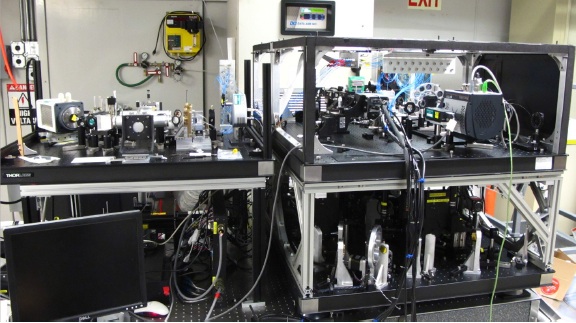
SCExAO is Subaru Telescope's flexible and versatile high contrast imaging testbed which operates from 600 - 2500 nm. It has two platforms: a visible upper bench (600 - 930 nm) consisting of a high sensitive pyramid wavefront sensor (PyHOWFS) correcting high-order aberrations at 750 nm, and an infrared lower bench (950 - 2500 nm) consisting of a channel for speckle control and a low-order wavefront sensor both operating at 1600 nm. SCExAO is the only instrument in the world that is equipped with the family of coronagraphs such as phase-induced aplitude apodized (PIAA), Vector Vortex, Four quadrant phase mask, Eight octant phase mask and Shaped pupil, all at the same platform.
SCExAO is situated at the Nasmyth platform of the Subaru Telescope as shown in Fig. 1, that feeds on Subaru's single conjugate adaptive optics system AO188 that has a 188 element curvature wavefront sensor. For detailed information on our ExAO testbed, please click SCExAO.

I am the lead person to deal with the low-order aberrations on SCExAO. I have developed and programmed (in Python and C language) a Lyot-based low-order wavefront sensor (LLOWFS) which is essentially designed to deal with the low-order aberrations for small IWA coronagraphs especially Phase-mask coronagraphs.
For detailed description of my work, please click on the links below:
Lyot-based Low-order wavefront sensor (LLOWFS)
Integration of LLOWFS with high-order Pyramid wavefront sensor on SCExAO
Laser guide star adaptive optics system (LGSAO188) of Subaru Telescope
© Garima Singh 2014