
Research
Academics
About me
650 N A'Ohoku Place
Hilo-96720, Hawaii
USA
garima.singh@obspm.fr
Ph: +1 (808) 934 5966
Fax: +1 (808) 934 5984
Subaru Telescope
LESIA
Focus tracking of the Laser guide star using the guide star acquisition system of Subaru Telescope LGSAO188
The basic requirement of an Adaptive Optics (AO) system is to find a bright guide star within the isoplanatic tip-tilt field of the astronomical object under observation. Finding a Natural guide star (NGS) within the isoplanatic field is not always practical and that is why Laser guide stars (LGS) are used to create a bright source for the real-time correction of the wavefront. But there are two difficulties with the use of the LGS:
1) Focal anisoplanatism: LGS samples a coneshaped volume of the turbulence in the optical path of the telescope, turbulence above the beacon is not measured, and that occurring below inside the cone is partially sampled!
2) Tip-tilt determination: LGS mode is suitable for measuring the high-order wavefront errors within an optical aperture, but it cannot be used to determine the overall tip-tilt caused by the turbulence. The position of the beam projected from the ground is randomly perturbed by the atmospheric turbulence and on its way back to the telescope it encounters the same amount of deflection from the turbulence, because the laser beam always appear to be on the axis no matter where the telescope is pointing. Due to lack of tip-tilt measurement and correction, the position of the image can not be stablized within the fraction of the spatial resolution of the science camera for long exposures.
So during the functioning of a LGS, the width of Sodium layer and the elevation of the guide star changes while tracking the stellar object, which in turn introduces the change in the focus of the LGS spot on the detector and also introduces the tip-tilt errors. When adaptive optics closes the loop, this change in focus of the laser spot is sensed as a defocus aberration in the atmosphere by the wavefront sensor and AO closed-loop then try to compensate for this defocus term thinking that it's coming from the atmospheric turbulence which lets the laser spot remain unfocused on the science camera. Correlating the change in the laser's focus due to elevation change with the focus aberration in the atmosphere, prevents image stabalization on the science camera, image dithering and LGS focus tracking.
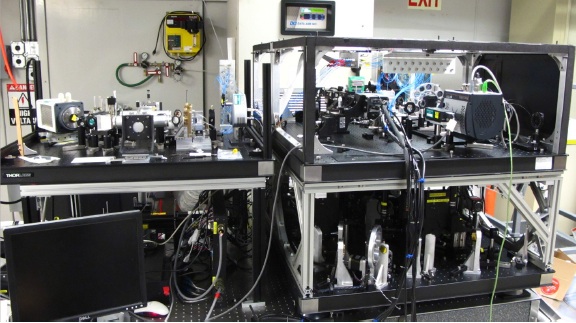
Subaru Telescopes LGSAO188 system uses two guide star acquisition unit (separate units for high-order and low-order wavefront sensor) to calibrate the change in the focus of the laser. I was involved in developing the model for determining the amount of focus change due to elevation change and defining the trajectory motion for the tracking of the laser focus. I developed a control software in IDL for focus tracking in real-time that also took in account the backlash for all the actuators of the guide star acquisition unit.
For detailed description of my work, please check out the final report in PDF here.
© Garima Singh 2014