Home
Research
Academics
About me
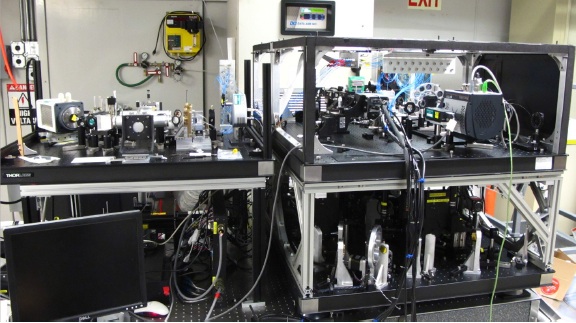 SCExAO in the laboratory at Hilo base facility.
Contact details
PhD student
Subaru Telescope
650 N A'Ohoku Place
Hilo-96720, Hawaii
USA
singh@naoj.org
garima.singh@obspm.fr
Ph: +1 (808) 934 5966
Fax: +1 (808) 934 5984
Click to visit
Subaru Telescope
LESIA
|
Ongoing (as of January 2015)
LLOWFS integration with Pyramid wave front sensor on SCExAO
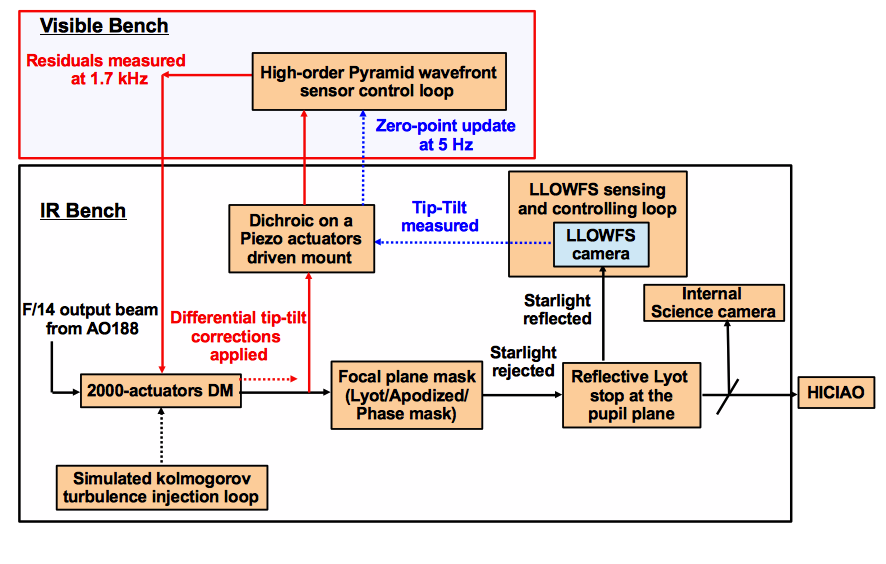
Figure 1: Simple flowchart showing the control flow of the configuration when LLOWFS interacts with the Pyramid wavefront sensor for the low-order corrcetions.
Overview
We integrated Pyramid wavefront sensor (PyWFS) with the LLOWFS control loop on SCExAO. A simplified flowchart of the simple integrator loop is shown in Figure 1. During LLOWFS closed-loop operation, the control commands are sent to the Pyramid wavefront sensor on the visible bench by driving the dichroic mounted on a motorized piezo actuators in x and y direction. In other words, LLOWFS estimates the differential tip-tilt errors on the IR bench and updates the zero-point of the Pyramid wavefront sensor. PyWFS, after receiving correction commands from LLOWFS, compensate for its zero point change by driving the DM.
With this configuration, only differential tip-tilt on the IR bench can be controlled at present.
On-sky Spectral Analysis, Science Target: ChiCyg
(September 2014 on-sky run, Seeing 0.6" - 0.7" )
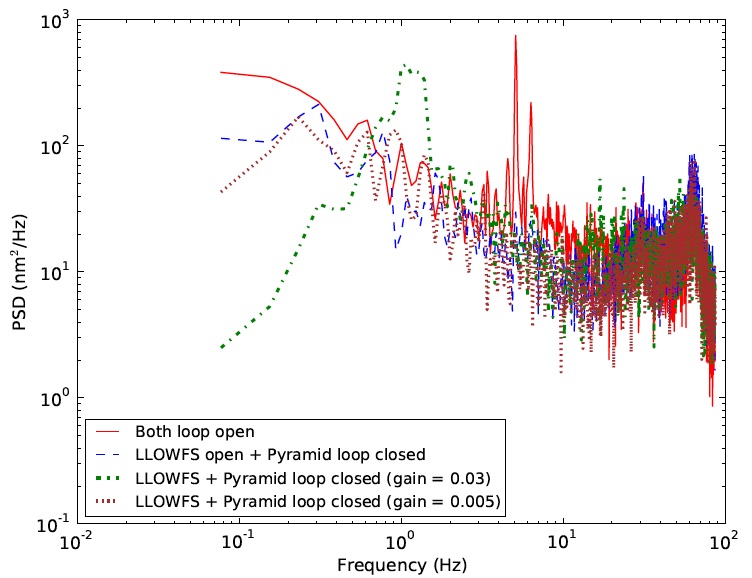
Figure 2 : On-sky power spectral density of the control loop for differential tip error on the IR bench. Red Curve: PyrWFS and LLOWFS loop open. Blue Curve: PyrWFS closes the loop at 1.7 kHz on tip-tilt. The vibration peak at 6 and 8 Hz are corrected by the PyrWFS control loop. Brown dotted and Green curve: On top of PyWFS closed-loop, LLOWFS also closes the loop with the gain of 0.005 and 0.03 respectively. With the gain of 0.03, LLOWFS corrected the disturbances at frequency < 0.2 Hz before overshooting at around 1 Hz. The on-sky closed-loop pointing accuracy of the dataset sampled at 0.2 Hz is few 10-3 λ/D. Note: 0.2 Hz is the typical frequency of the science facility instrument (example: HICIAO) and LLOWFS closed-loop performance is more sensitive to the slow varying frequency component of the turbulence at 0.2 Hz.
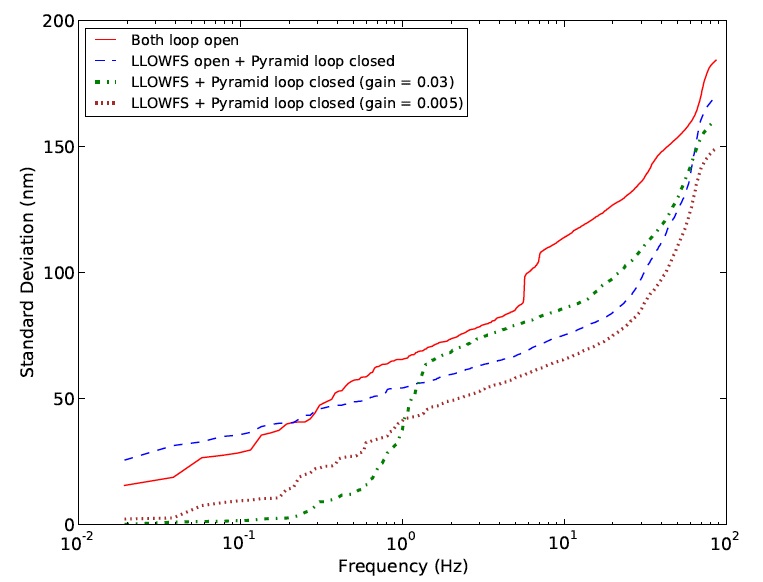
Figure 3 : Showing the cumulative sum frequency of the open and closed loop. Its clear that when LLOWFS closed the loop with the gain of 0.03, the disturbances < 0.2 Hz are 90% compensated.
Our paper "On-sky demonstration of the Lyot-based low-order wavefront sensor and its integration with Pyramid wavefront sensor on the Subaru Coronagraphic Extreme Adaptive Optics System. Singh et al. 2015" is under preparation.
Back.
© Garima Singh 2014
|
