Next: Applying the transformation function:
Up: Wavelength Calibration and Distortion
Previous: Determination of the distortion
Making transformation of coordinates: the FITCOORDS task
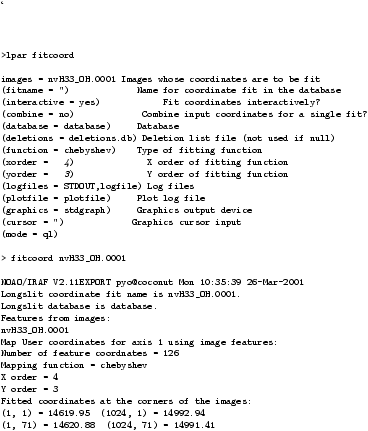
The FITCOORDS task determines the user coordinates from the data produced with the IDENTIFY and REIDENTIFY tasks.
The dispersion solution is theoretically represented by Eq. 3 for an ideal case.
The transformation function in the dispersion direction (X) can be set to a fourth or fifth order function in IRAF3.
A slit image is represented by a parabolic function as explained in § 2.4. The transformation function in the spatial direction (Y) can be set to a third order equation or second order equation in IRAF if the curvatures of slit images are negligible.
Figure 42:
An example of the parameter setting and execution results of the FITCOORDS task.
 |
Footnotes
- ... IRAF3
- In IRAF, the order of an equation means the number of terms in it.
Tae-Soo Pyo
2003-05-29