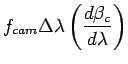
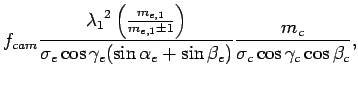
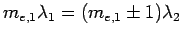
 and the subscript
  and
and  denote the echelle and the cross-disperser, respectively.
Definitions of the other parameters are the same as those in Eqs. 3 and 4.
Since the variation of
denote the echelle and the cross-disperser, respectively.
Definitions of the other parameters are the same as those in Eqs. 3 and 4.
Since the variation of  on the detector can be ignored and (
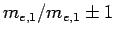 ) is nearly unity, the separation is simply proportional to the square of the wavelength and the order of the cross-disperser.
We can control the separation of the spectrum by adjusting the order of the cross-disperser or exchanging cross-dispersers.
) is nearly unity, the separation is simply proportional to the square of the wavelength and the order of the cross-disperser.
We can control the separation of the spectrum by adjusting the order of the cross-disperser or exchanging cross-dispersers.
On the other hand, when a prism is used as a cross-disperser, the separation  is
is
 is the angular dispersion of the prism,
  is the base length of the prism,
  is the beam width, and
  is the refraction index of the prism.
Prisms have high and nearly constant efficiency which is principally related to the transmittance of the material.
This allows us to use the detector area efficiently because the separation between the spectra increases more gradually than the case when we use a grating: the separation with a prism cross-disperser is proportional to
is the refraction index of the prism.
Prisms have high and nearly constant efficiency which is principally related to the transmittance of the material.
This allows us to use the detector area efficiently because the separation between the spectra increases more gradually than the case when we use a grating: the separation with a prism cross-disperser is proportional to  and that with a grating is proportional to
  .
Prisms are usually used for low spectral orders.
In order to get sufficient separation, two prisms are used in sequence along the optical axis after an echelle grating or one prism is used before an echelle grating in order that the reflected and diffracted light by the echelle can be diffracted again.
.
Prisms are usually used for low spectral orders.
In order to get sufficient separation, two prisms are used in sequence along the optical axis after an echelle grating or one prism is used before an echelle grating in order that the reflected and diffracted light by the echelle can be diffracted again.
In the UV and visual wavelengths, many echelle spectrographs use prisms for cross-dispersers: e.g. FEROS (Kaufer and Pasquini, 1998), FOCES (Pfeiffer et al., 1998), the echelle spectrograph of the MacDonald Observatory 2.7 m telescope (Tull et al., 1995), the Hamilton echelle (Vogt, 1987), etc.
In the near infrared region a few echelle spectrograph use prisms for cross-dispersers: GRIS (Thompson et al., 1994), KSPEC (Hodapp et al., 1994), LEWIS (Imanishi et al., 1996), etc.
Difficulty of using prisms in the near infrared region is because most optical materials have the minima in
 in the near-infrared.