
Imaging complex sources with Kernel-phase
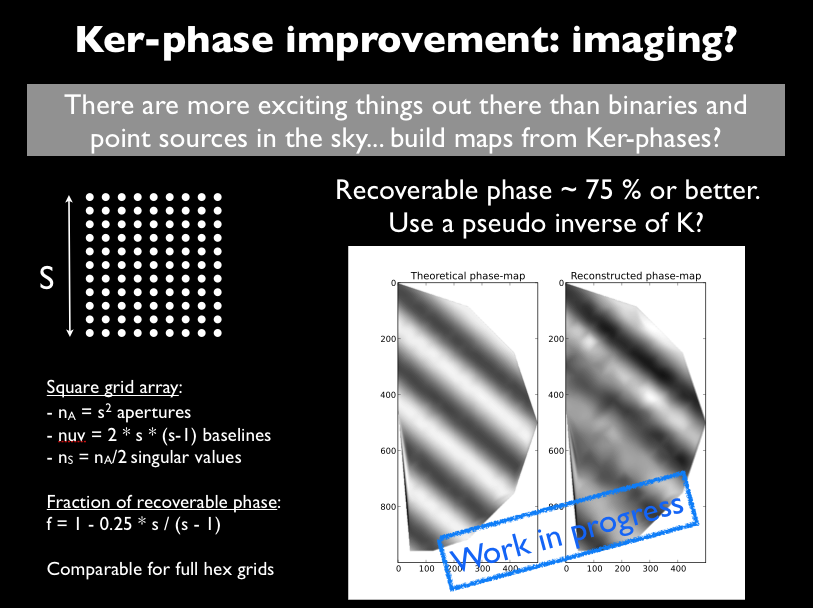
What geometry provides the best phase information recovery?
The fact that kernel-phase relations exist for any type of array geometry brings the following question: if the AO correction is good enough, is it worth masking at all? There are multiple things to consider to answer this question, and the final answer is likely to depend on a lot of things. This little study focuses on the phase information recovery capability of three types of geometries, and to demonstrate the validity of the conclusions, different arrays of increasing complexity are used.
The reference geometry is always the compact non-redundant configuration from the 1971 paper by Golay. It is compared against the highly redundant sparse array that fits within the same global footprint, with elements falling on each step of the hexagonal grid used to build the Golay. Finally, a solution of intermediate redundancy, refered to as the ring configuration, is shown to always exhibit superior phase information recovery capability.
Configurations
Designs based on the Golay 9 compact configuration
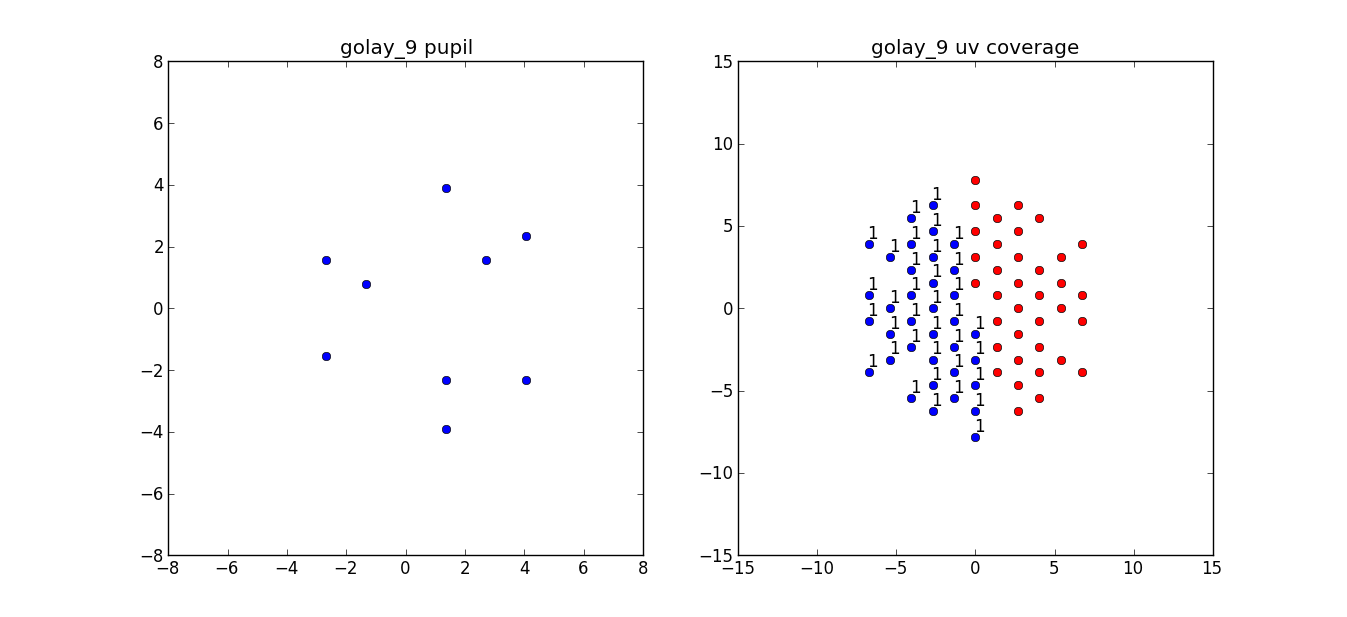
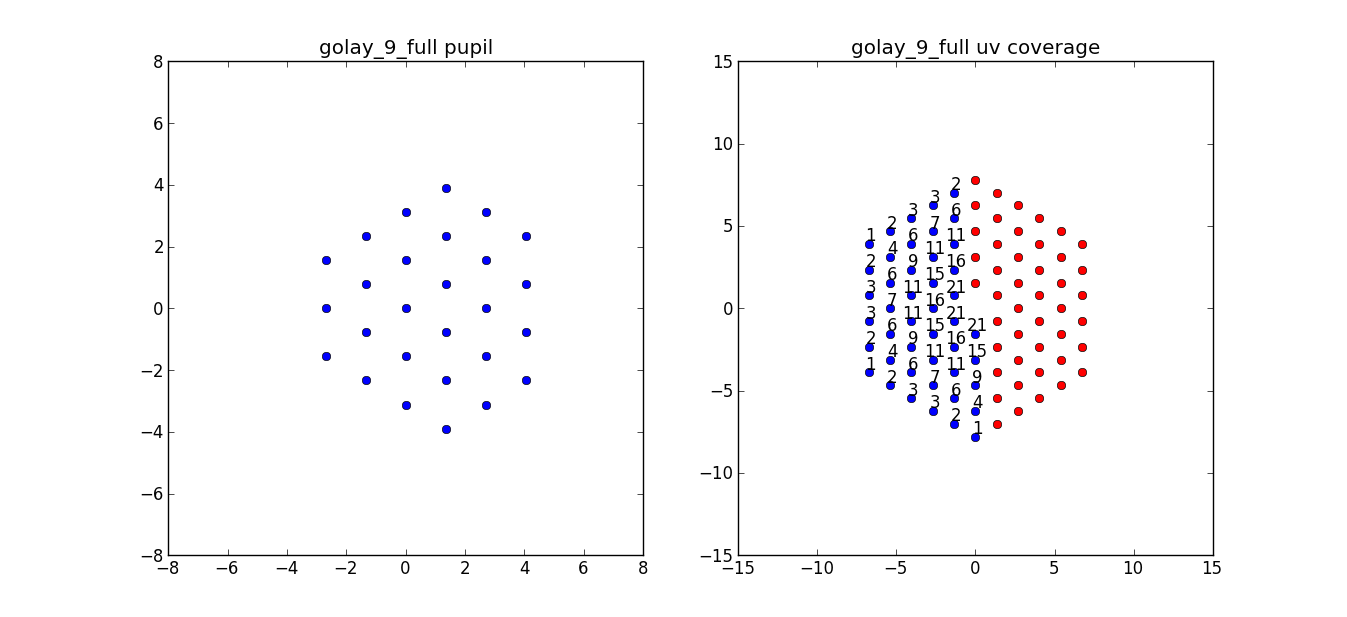
The design of most non-redundant masks used for broad-band filters in instruments is based upon this design, which provides a very good coverage of the uv-plane. A non-redundant 9-aperture array allows to sample 9*(9-1)/2=36 distinct uv sample points, and can produce (9-1)*(9-2)/2=28 independent closure- or kernel-phases. The smallest fully redundant array that would fit within the same footprint is made of 27 sub-apertures, forming 45 distinct baselines. Only 19 kernel-phases can be constructed from these uv measurements, so the fraction of total available information is clearly in favor of the non-redundant array.
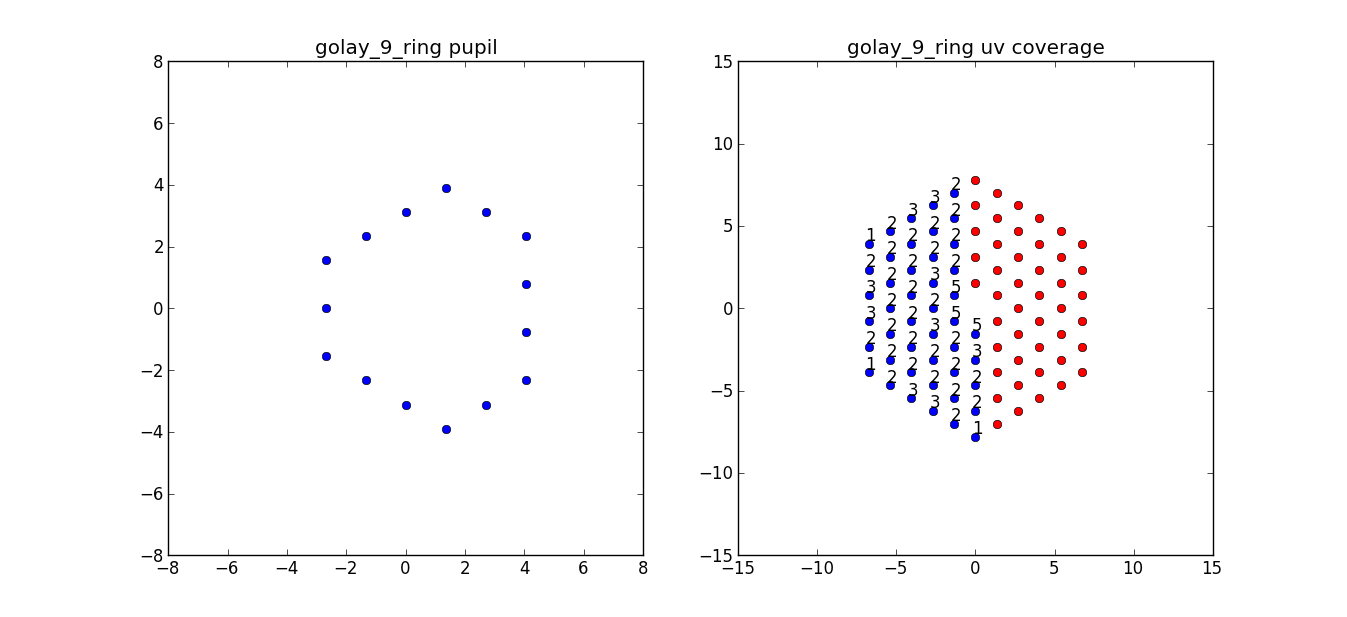
Using only the 15 apertures forming the outer outline of the array produces the same number (45) of uv samples, and the shortest baselines become significantly less redundant than for the complete array. A much larger number of kernel-phases (31) can be extracted from this configuration, doing even slightly better than the non-redundant array (28). The total fraction of recoverable phase information becomes now comparable with the the Golay 9 configuration. Note that at least one more kernel-phase relation can be obtained by suppressing one additional element from the array, without affecting the uv coverage.
The following figures present the three scenarios that were just described. The properties of the different configurations are summarized in the table that follows the figures.
| Golay 9 | Full | Ring | |
|---|---|---|---|
| NA | 9 | 27 | 15 |
| fA | 0.8 (NUV=36) |
1.0 (NUV=45) |
1.0 (NUV=45) |
| fR | 0.77 (NK=28) |
0.42 (NK=19) |
0.68 (NK=31) |
| fA*fR | 0.62 | 0.42 | 0.68 |
- NA = number of apertures in the array
- NUV = number of distinct uv samples
- NK = number of kernel-phases
- fA = fraction of available uv plane phase
- fR = fraction of recoverable uv plane phase information
Designs based on the Golay 10 compact configuration
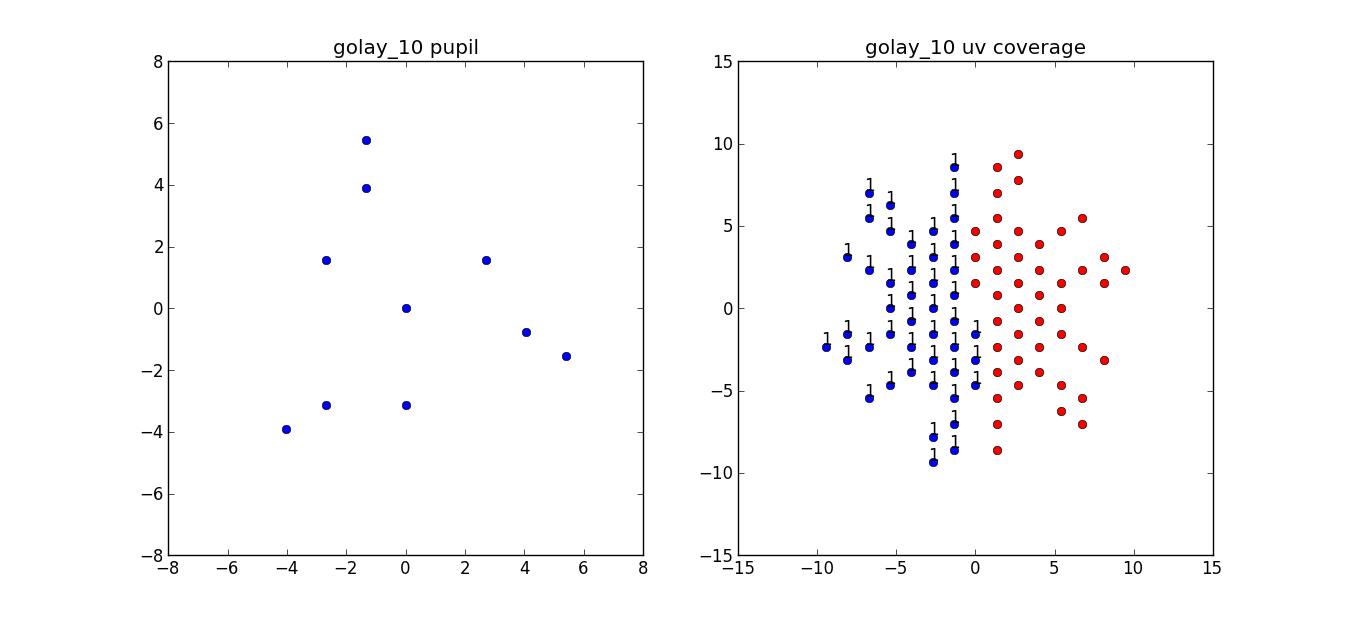
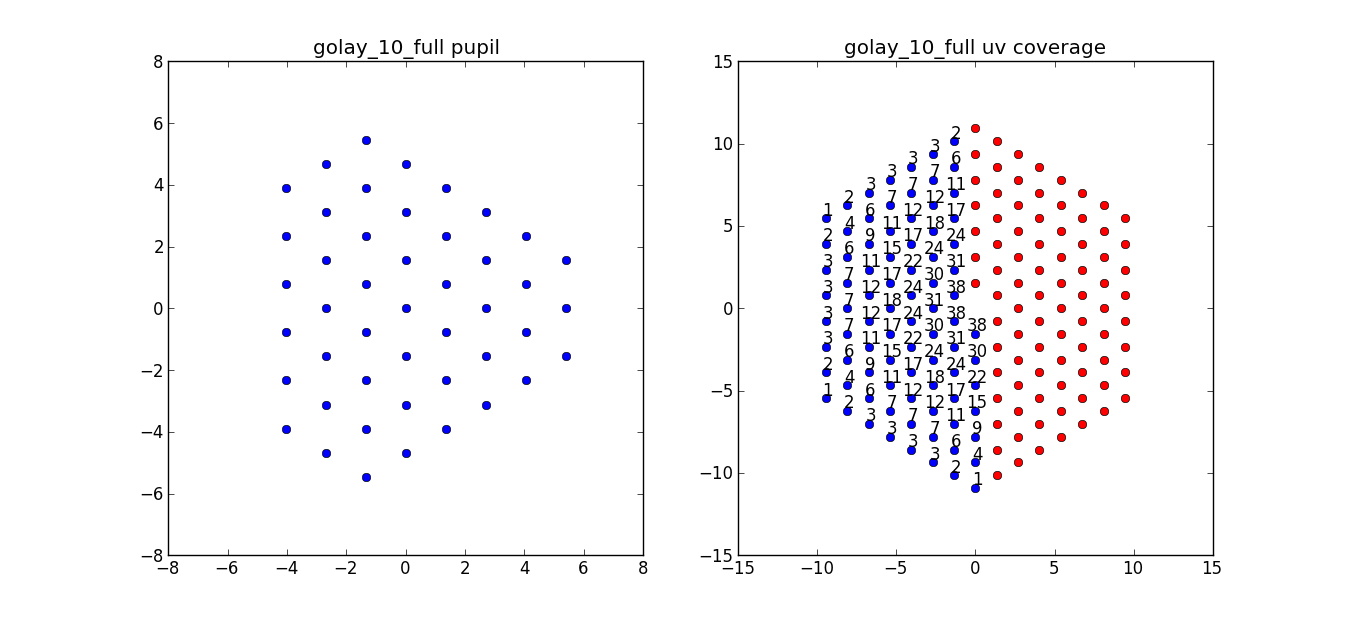
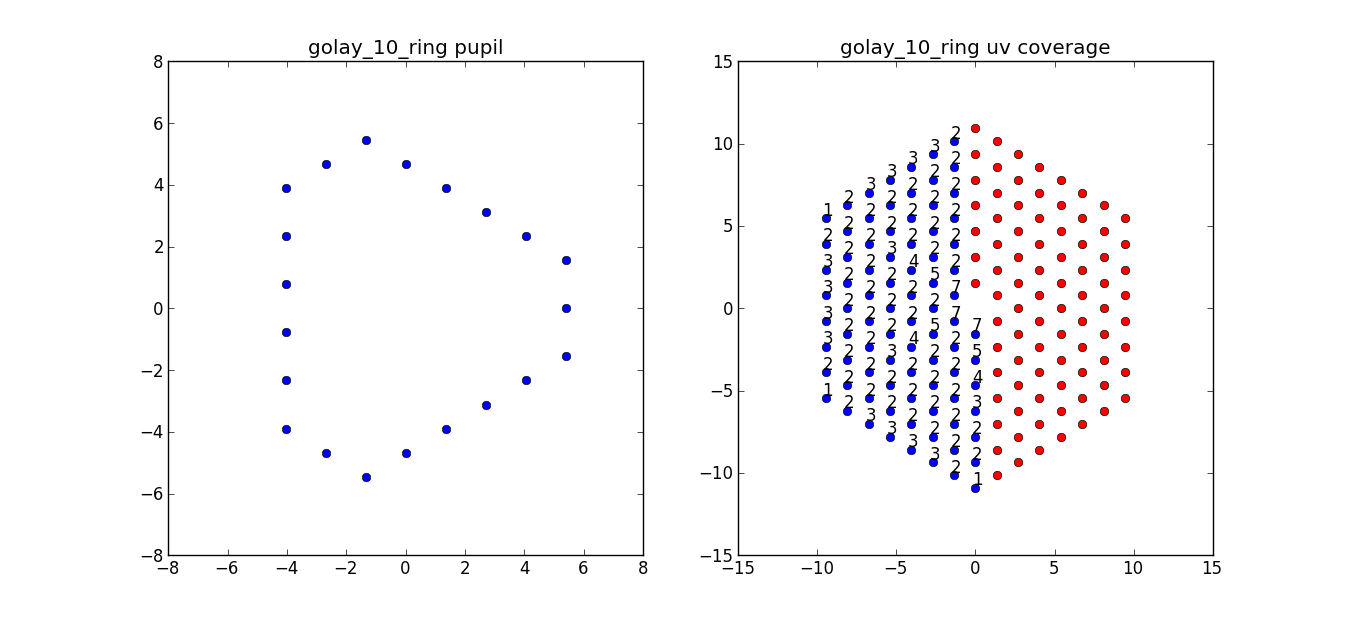
The trend observed for the Golay 9 is confirmed in the case of this 10-aperture array: the ring configuration offers superior fraction phase recovery. Because of the increase in symmetry of the array geometry, the fully redundant configuration performs rather well, being slightly more performant than the Golay 10.
The following figures present the three scenarios: Golay 10, fully redundant with same footprint and ring configuration. The properties of the different configurations are again, summarized in the table that follows the figures.
| Golay 10 | Full | Ring | |
|---|---|---|---|
| NA | 10 | 46 | 21 |
| fA | 0.54 (NUV=45) |
1.0 (NUV=84) |
1.0 (NUV=84) |
| fR | 0.42 (NK=36) |
0.46 (NK=39) |
0.76 (NK=64) |
| fA*fR | 0.42 | 0.46 | 0.76 |
- NA = number of apertures in the array
- NUV = number of distinct uv samples
- NK = number of kernel-phases
- fA = fraction of available uv plane phase
- fR = fraction of recoverable uv plane phase information
Designs based on the Golay 12 compact configuration
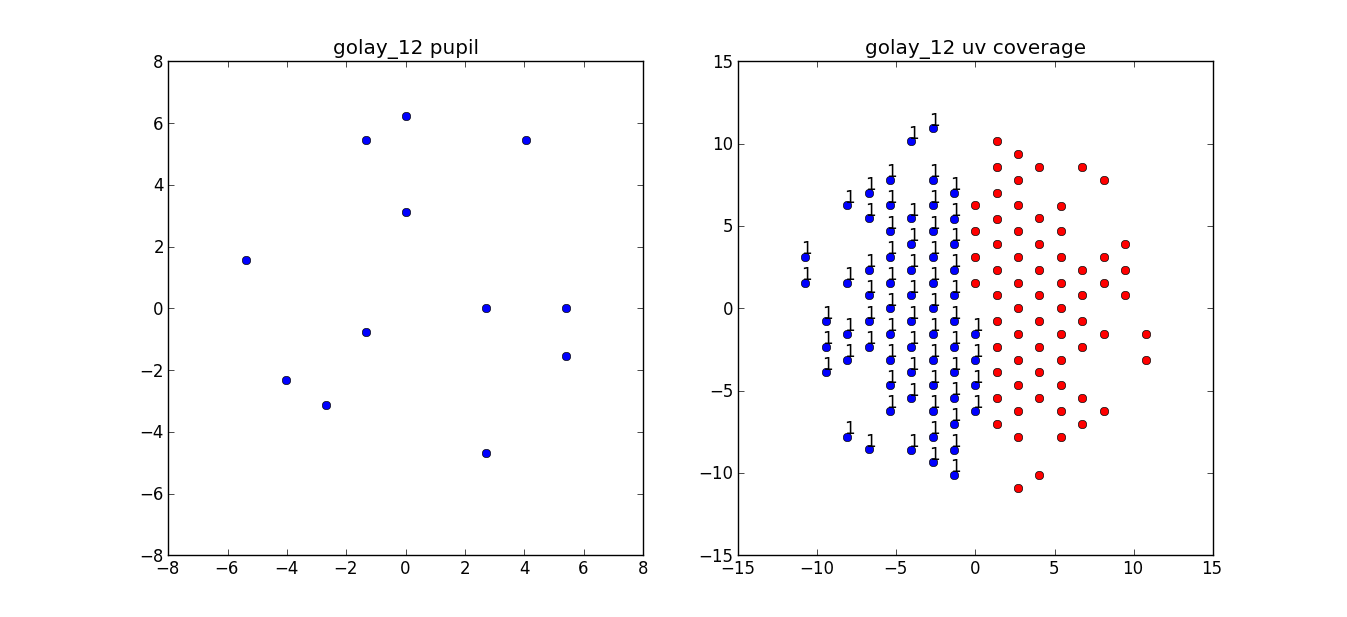
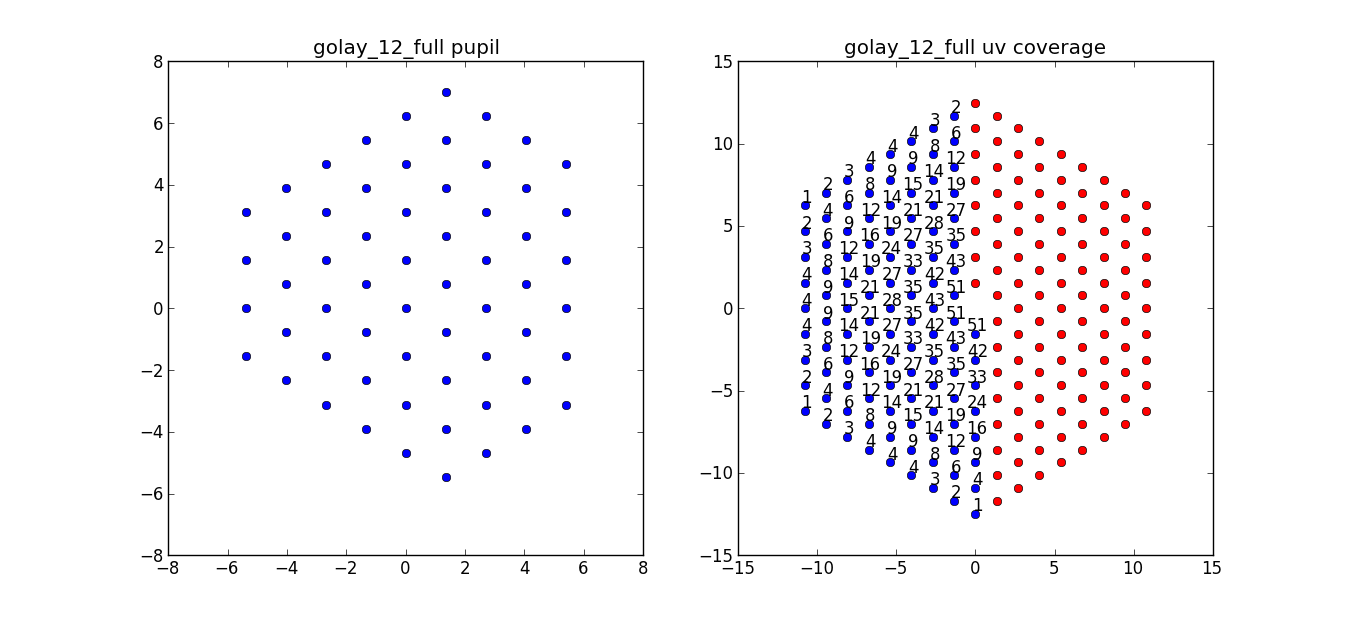
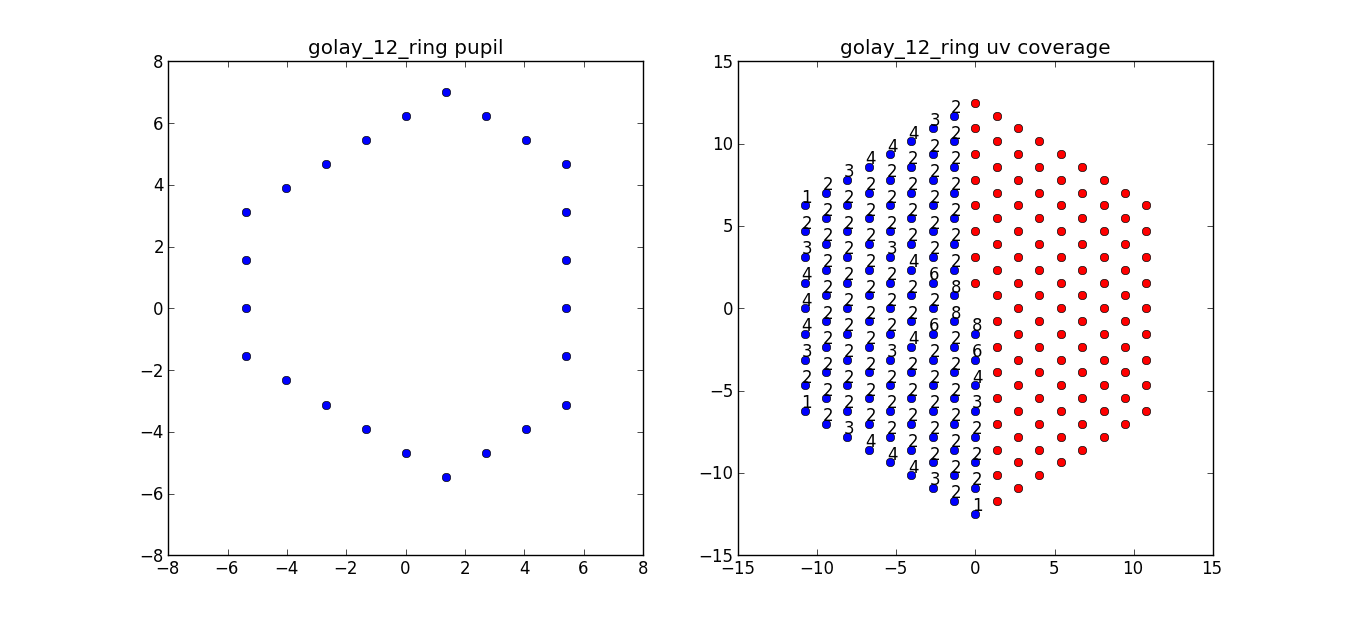
| Golay 12 | Full | Ring | |
|---|---|---|---|
| NA | 9 | 27 | 15 |
| fA | 0.8 (NUV=66) |
1.0 (NUV=108) |
1.0 (NUV=108) |
| fR | 0.83 (NK=55) |
0.45 (NK=49) |
0.79 (NK=85) |
| fA*fR | 0.65 | 0.45 | 0.79 |
- NA = number of apertures in the array
- NUV = number of distinct uv samples
- NK = number of kernel-phases
- fA = fraction of available uv plane phase
- fR = fraction of recoverable uv plane phase information