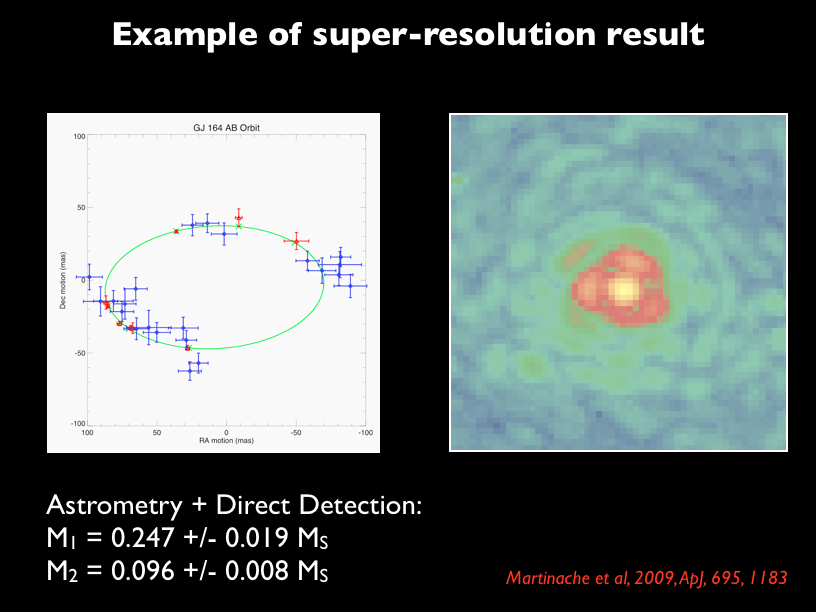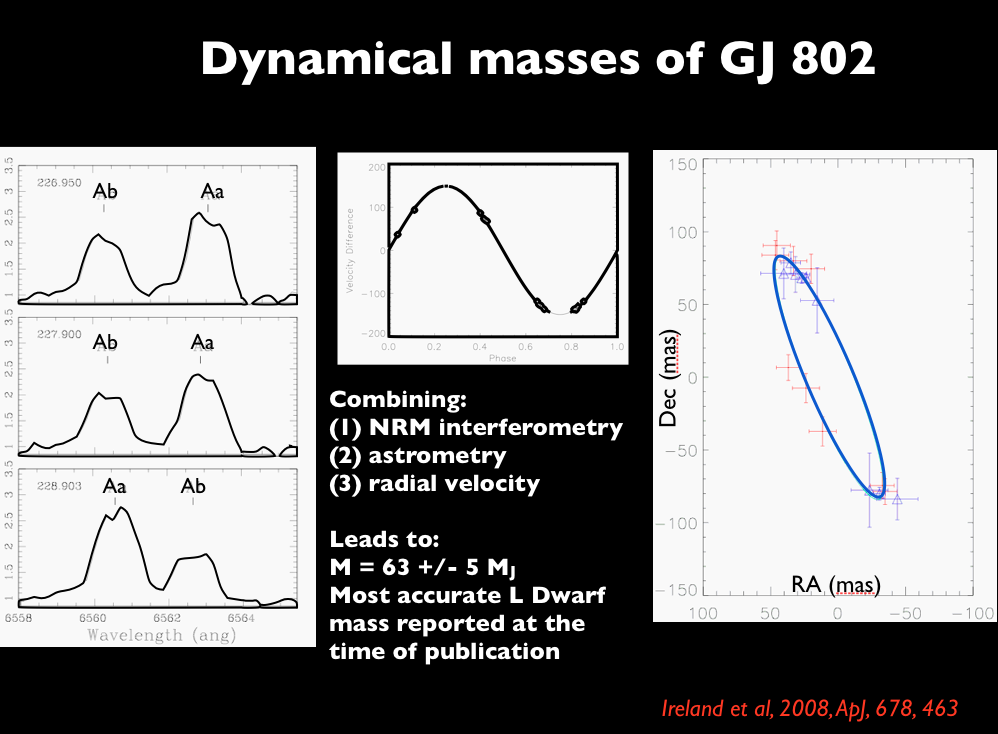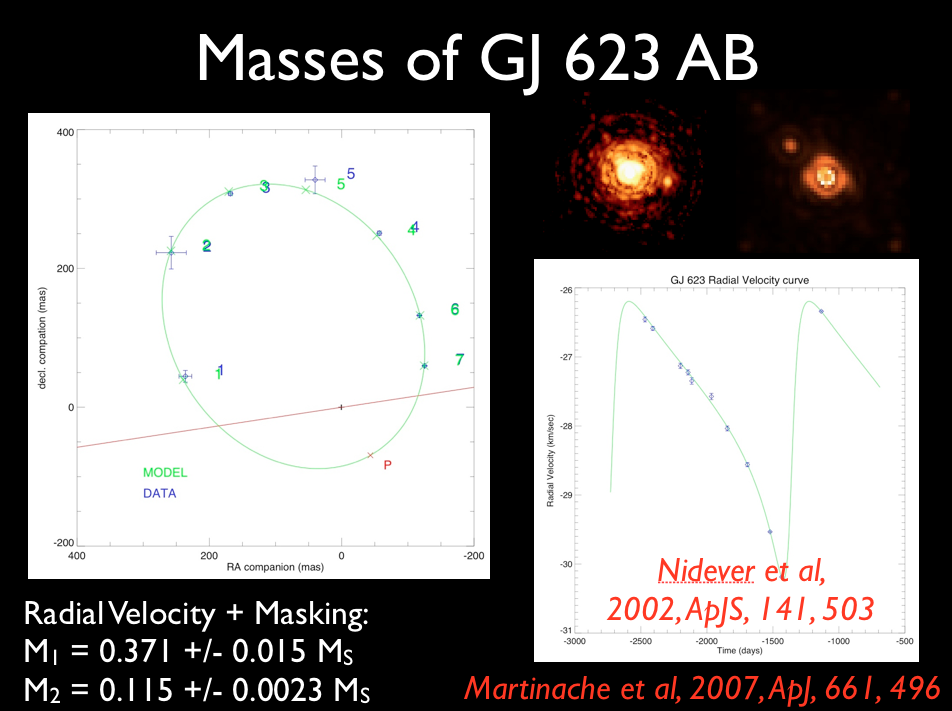
The power of interferometry
In non-redundant aperture Masking Interferometry, a N-hole pupil mask turns the extremely redundant full aperture of a telescope into a simpler (non-redundant) interferometric array. Taking into account the geometry of the pupil (segmentation, central obscuration and spider vanes) as well as the spectral bandwidth, the pupil is designed such that each baseline (a vector linking the center of two holes) is unique: the mask is non-redundant in teh sense that each spatial frequency is only sampled once.
In a sense, non-redundant masking is a form of imaging with an odd-looking PSF that displays multiple sharp peaks, whereas a traditional diffraction-limited PSF is dominated by only one peak. However, the real virtues of the masking PSF only appear after the image is Fourier-transformed: all spatial frequencies sampled by the mask appear as well separated peaks containing both amplitude and phase information. The advantages of this approach are that:
- Unlike conventional PSF co-addition, dominated by a speckle noise floor, the information extracted from the masking data can be averaged to reduce noise, even in the presence of slowly-varying speckles.
- Non-redundancy ensures that the complex visibilities can be used to form closure-phases, an observable quantity that calibrates wavefront residual errors as well as non-common path errors between the science and the sensing arms of the instrument.
- Because of this level of calibration, the traditionally accepted full-aperture Rayleigh criterion limit of 1.22 λ/D can be transcended. In practice, the inner working angle of NRM masking is close to 0.5 λ/D.
- The outer working angle is set by the shortest baseline, typically 4 λ/D: the masking search space nicely complements that of coronagraphy.
How the closure-phase works
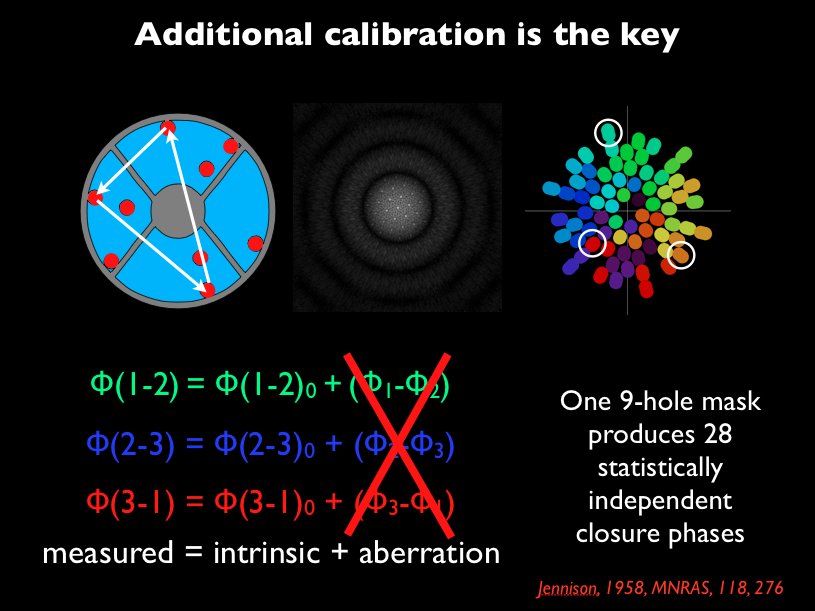
It may seem perverse to throw away most of the telescope's collecting area, but the 10-20% mask transmission price paid for the masking, comparable to most high performance coronagraphs' throughput - SCExAO excluded - provides a dramatic increase in signal-to-noise ratio, that results in improved inner working angle. Today's ground based masking interferometry achieves stability of 0.5 degrees on the closure phase, hence passively stabilizing the phase at the level of λ/500 to λ/1000, performance that will only be matched by the next generation of ExAO systems.
Example of results obtained using NRM-interferometry