


 ) of a A0 type standard star, the flux of the object can be calibrated by the following steps.
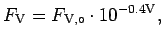
First, calculate flux density at 0.5556  m (
m ( ) of the standard star from its -band magnitude (V),
 is the flux density at
  mag (
mag ( 3.44E-08 W m
 m
m ;Tokunaga (2000)).
Second, calculate flux density at  m (
m ( ) of the standard star as follows,
Third, calculate a scaling factor by dividing the spectrum by the standard star spectrum corrected for their wavelength sensitivity.
Fourth, calibrate the flux of the object spectrum by multiplying the scaling factor.
Figure 50 shows example frames of calibrated apertures.
If  magnitude of the standard star is known,
 at 1.644 m and
  must be better for -band flux calibration.
The effective temperature of A0 type star is 9480 K.
When the standard star is not A0 type star, the effective temperature depends on their color index (see Tokunaga, 2000).
must be better for -band flux calibration.
The effective temperature of A0 type star is 9480 K.
When the standard star is not A0 type star, the effective temperature depends on their color index (see Tokunaga, 2000).

![\begin{figure}
\lq
\begin{center}
\includegraphics[width=6in]{H_calibrated.eps}
\end{center}
\end{figure}](img288.png)